


Shopping Cart
There are no more items in your cart















Sanremo: Arisa vince tra gli italiani all’estero
Sanremo is always Sanremo: people talk about it everywhere, for days, and every year it becomes a thermometer (more emotional than scientific) of tastes, identity, and a sense of belonging. But what happens if the ones “voting” are not Italians in Italy, but those living outside the country?
The result is an interesting snapshot: some names overlap with the official televote, but the rankings change quite significantly.
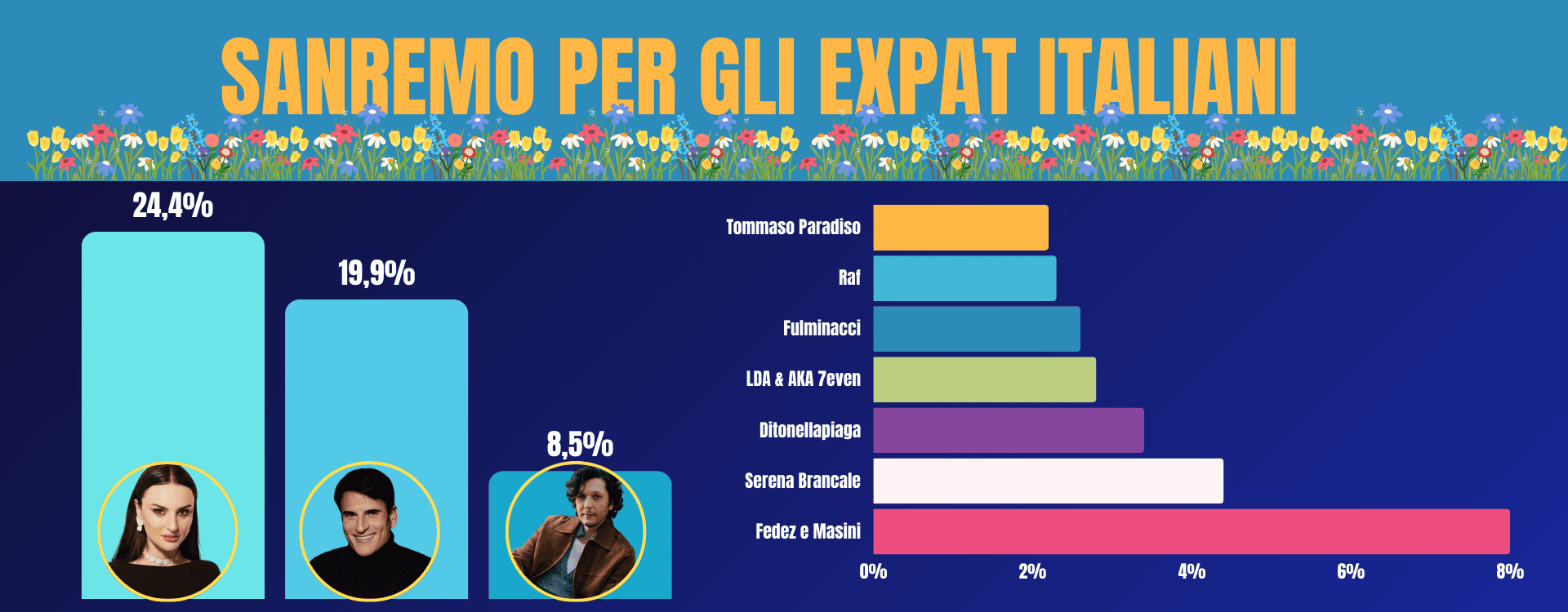
The overall expat ranking: Arisa in first place
If we look at the overall ranking of Italians abroad, the podium is not what one would expect based on the televoting data in Italy.

Top 10 expats (overall ranking)
- Arisa, “Magica favola”: 24.39%
- Sal Da Vinci, “Per sempre sì”: 19.85%
- Ermal Meta, “Stella stellina”: 8.37%
- Fedez and Marco Masini, “Male necessario”: 7.94%
- Serena Brancale, “Qui con me”: 4.36%
- Ditonellapiaga, “Che fastidio”: 3.39%
- LDA & AKA 7even, “Poesie clandestine”: 2.81%
- Fulminacci, “Stupida sfortuna”: 2.57%
- Raf, “Ora e per sempre”: 2.27%
- Tommaso Paradiso, “I romantici”: 2.23%
The most evident data point is that Arisa and Sal Da Vinci swap positions compared to the ranking emerging from the Italian vote. And then there is an even clearer element: Ermal Meta performs strongly among expats, while other major players in the Italian televote are much less dominant in our survey.
The most active countries and how voting changes: Germany, France, Argentina, Spain
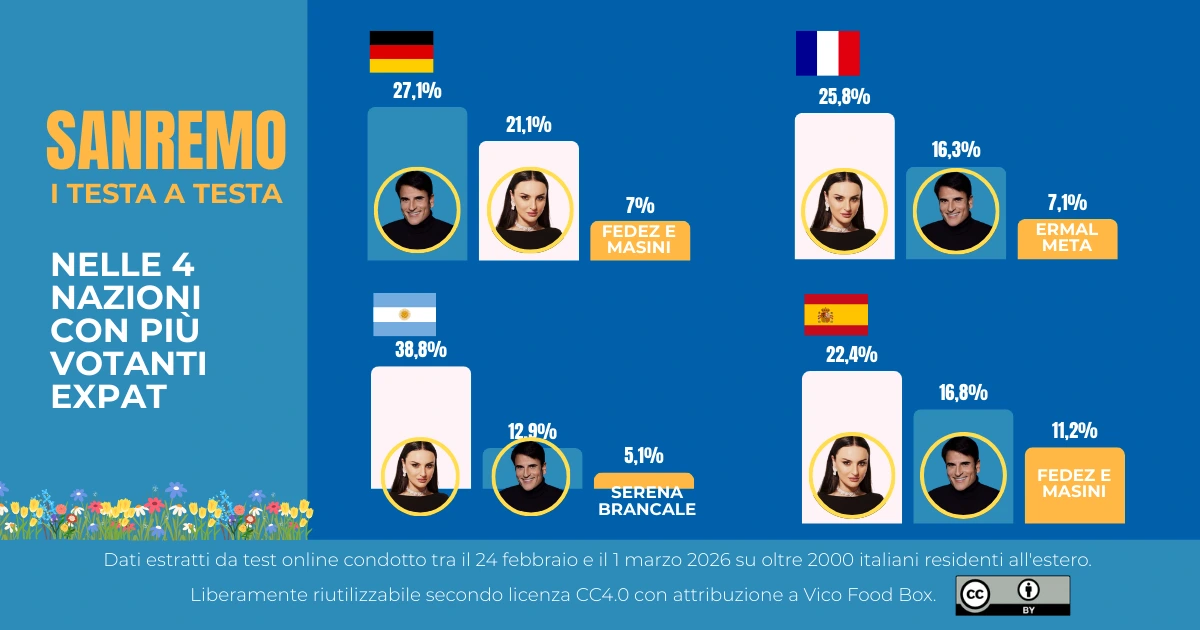
Among the countries that voted the most are, in order, Germany, France, Argentina, and Spain. Here too, preferences tell different stories.
Top 5 in Germany: Sal Da Vinci ahead of Arisa
- Sal Da Vinci: 27.11%
- Arisa: 21.13%
- Fedez and Marco Masini: 7.04%
- LDA & AKA 7even: 5.99%
- Serena Brancale: 5.28%
In Germany, the head-to-head flips: Sal Da Vinci wins, with Arisa close behind.
Top 5 in France: Arisa first, but Sal holds up
- Arisa: 25.83%
- Sal Da Vinci: 16.25%
- Ermal Meta: 7.08%
- Fedez and Marco Masini: 5.83%
- Tommaso Paradiso: 4.58%
In France, Arisa is clearly ahead and the chasing group changes: Paradiso enters the top 5.
Top 5 in Argentina: an even stronger “Arisa effect”
- Arisa: 38.76%
- Sal Da Vinci: 12.92%
- Serena Brancale: 5.06%
- Leo Gassmann: 4.49% (tied)
- Fedez and Marco Masini: 4.49% (tied)
The figure here is striking: Arisa comes close to 39%. In other words, nearly 4 out of 10 votes.
Top 5 in Spain: Arisa still first, then Sal
- Arisa: 22.4%
- Sal Da Vinci: 16.8%
- Fedez and Marco Masini: 11.2%
- Ermal Meta: 7.2% (tied)
- Serena Brancale: 7.2% (tied)
In Spain, a dynamic similar to the overall ranking returns: Arisa in front, Sal second, and a double tie for fourth place.
Comparison with the official televote
According to official televoting data, the top 5 is:
- Sayf 26.4%
- Sal Da Vinci 23.6%
- Arisa 19.2%
- Ditonellapiaga 18.9%
- Fedez and Marco Masini 11.9%
In the vote of Italians abroad, Sal Da Vinci and Arisa remain strong, but their positions are reversed and, above all, the context changes. Arisa rises to first place, Sal Da Vinci remains consistently high, while Sayf—first in the official televote—carries much less weight in the expat ranking. At the same time, Ermal Meta emerges more strongly, entering the top positions among expats.
In short: some names are confirmed, but the proportions change significantly.
What it means (and what it does not)
This survey aims to be a snapshot rather than a scientific measurement. Its main purpose is to understand whether, within an event that tends to “close ranks” (Sanremo), interesting differences emerge when the point of observation is outside Italy.
From these numbers, something can be glimpsed: some key figures remain the same (Sal Da Vinci and Arisa), but the hierarchies change, with Arisa leading the expat ranking, and the relative weights compared to the official televote also shift. Likewise, the strong presence of Ermal Meta and the differences between countries suggest that the context in which people live may influence preferences—or at least the way they “support” the Festival.
This is not definitive proof nor a general rule: it is a curious data point that helps tell a simple idea. Sanremo is also this: the same competition, listened to from two different contexts, can “sound” different.
Methodological note
The data were collected online via the questionnaire “Who do you want to win Sanremo?”, created on the Tally platform and equipped with anti-duplication measures. A total of 2,961 submissions were collected (gross data). For the purposes of the analysis, 2,065 valid responses were considered (net data), including exclusively the votes of those who declared themselves Italian and resident outside Italy. Responses for which the declared country was not consistent with the respondent’s associated location were also excluded. The percentages shown in the country rankings refer to the total number of valid votes for each country.
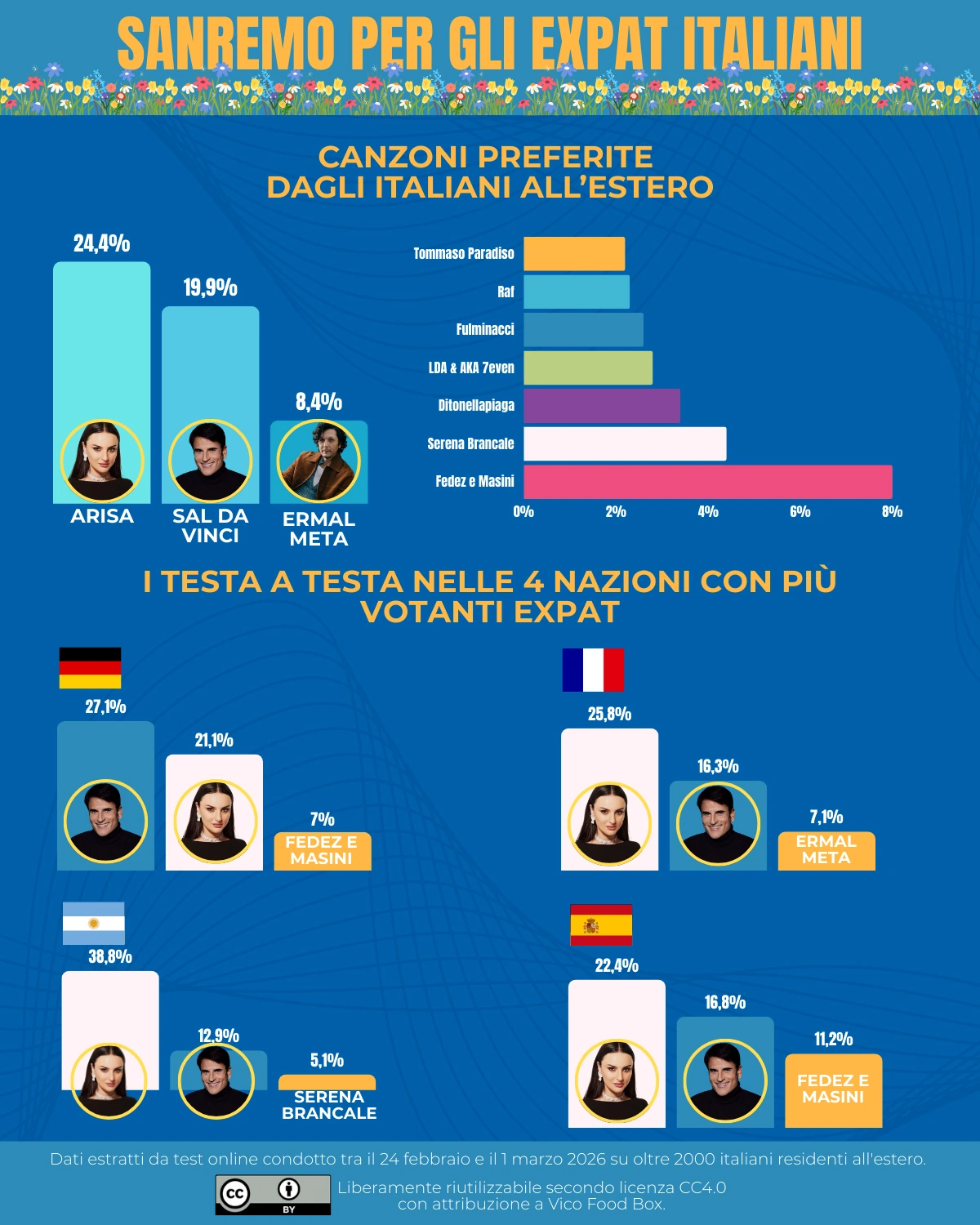
Summary infographic
Posted in:
Italian lifestyle

Search in blog
Blog categories
Latest posts
Pasta is simple. People overcomplicate it
Read more
Cooking pasta is not difficult. You do not need tricks, rituals, or a dramatic Italian ancestor watching you from the...